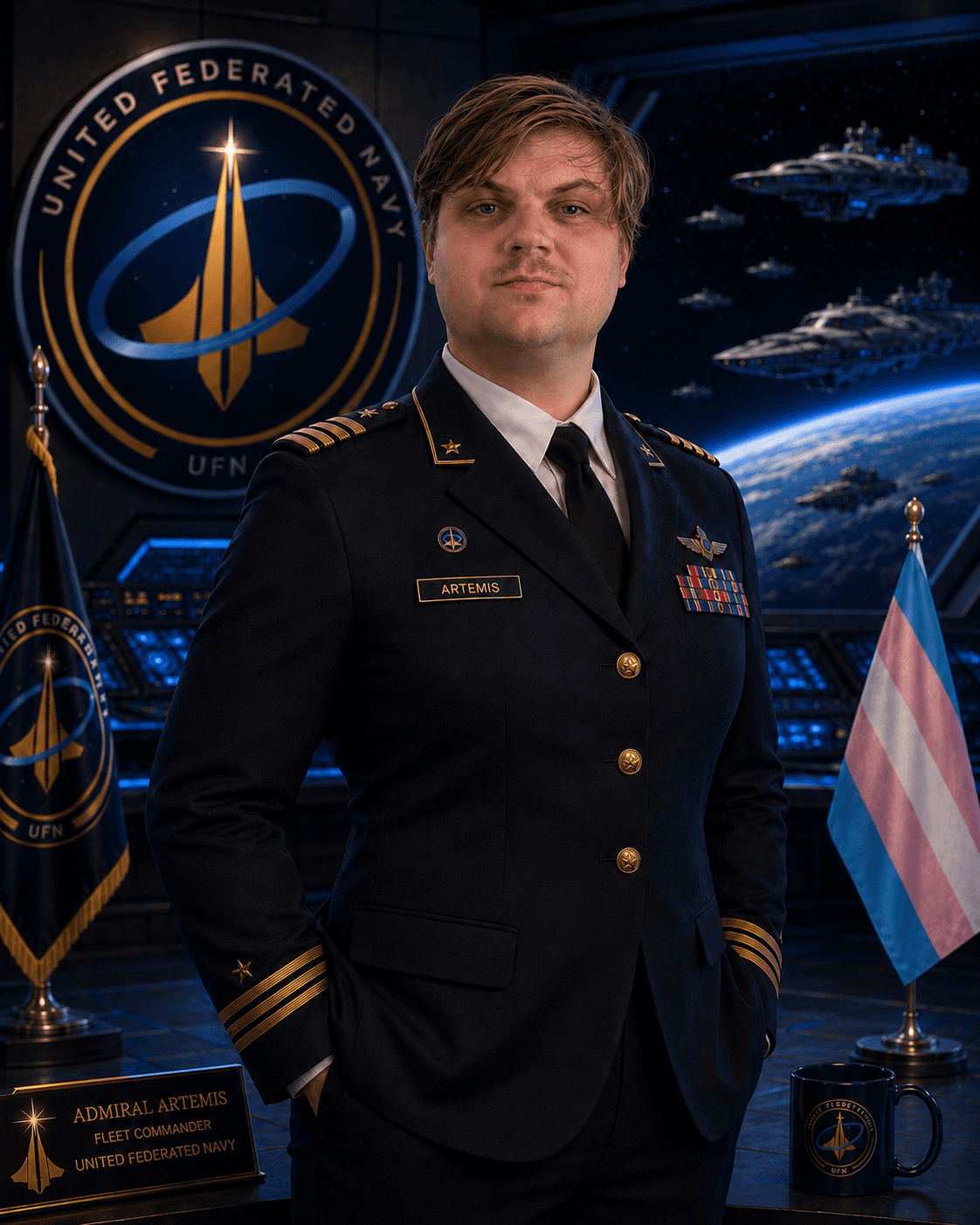
Admiral Artemis Winstanley holds ultimate command authority over the United Federated Navy, a position reached faster than any officer in the Fleet's thirty-five year history — and from the engine room rather than the bridge.
Commissioned into the Engineering Corps at twenty, Artemis spent the early years of service in the access tunnels and reactor bays of Fleet vessels rather than on the command deck, a fact never volunteered and never denied when raised. The reputation built there was unglamorous and reliable: ships came back from deployment in better condition than they left in, and the people running them came back alive.
Promotion followed promotion at a pace the Engineering Corps had not seen before or since, each one earned through results rather than ambition. The Flight Controller qualification required for Captain came late and was, by the Admiral's own account, "the most useful thing I did badly." Flag rank followed a transfer from Engineering Corps leadership into Fleet Command proper, and the Admiral has held the dual post of Fleet Commander and Head of the Bureau of Personnel since assuming the rank, a combination some have questioned and none have argued against for long.
The loss of the UFN Hope to the Hope Destroyers on 25 January 2247 came within the Admiral's first year holding the Fleet. There were no casualties, aided by the first fleet-wide test of emergency evacuation teleportation pods. Artemis signed the loss report personally rather than delegating it, and has spoken on the matter exactly once, in public, since. Officers who served before the loss and after describe a Fleet Commander who did not change so much as sharpen.
Artemis speaks rarely in council and briefly in person. Officers who have served long enough to earn a word of praise remember exactly what was said, and exactly when.
Engineering Corps Years
The Steadfast posting shaped more of the Admiral than any assignment since. Junior engineering officers on a Bastion-class gunship learn fast that a ship built to hold the line has no room for sloppy work, and Artemis' watch reports from those years are, by Fleet Command archive standards, unusually thorough for someone barely into their twenties. A senior engineer aboard reportedly said the young ensign "fixed things that weren't broken yet," meant as a complaint at the time and repeated since as a compliment.
The Long Watch years, first as Engineering Officer and later as Chief Engineer across two ranks, are where the reputation properly set. Ship's logs from that period show fewer unscheduled repairs than any comparable vessel in service, and crew retention on the engineering deck ran well above Fleet average, a detail the Admiral has never commented on but has also never denied caring about. Command aboard the Clear Horizon followed, brief by the standards of the ranks around it, before the Engineering Corps called their best officer home to lead it outright.
Those who serve under the Admiral now and ask about the tunnel years get little. Those who don't ask get even less. It is, by all accounts, not modesty. It's just not considered relevant to the work in front of her.
Engineering Corps Ties
Artemis' postings overlapped twice, during the Engineering Corps years, with an officer who would go on to lead that Corps in turn — long before either held flag rank. What passed between them on those postings is not part of the record, and neither has chosen to make it so.
The later appointment to Chief Engineering Officer was, on paper, a straightforward promotion of a highly qualified candidate. It has also been noted, by officers with long enough memory, that the Corps has run with unusual consistency since. Whether this reflects two people who think about the work the same way, or simply a well-made appointment, is not a distinction the Admiral has ever felt required to draw.
Commendations and Honours
- Meritorious Service Cross — awarded 2244, for sustained engineering leadership aboard the UFN Clear Horizon
- Federation Cross of Valour — awarded 2246, citation sealed pending Board review
- Distinguished Command Medal — awarded 2246, upon assumption of Fleet Command
- Additional citations from the Engineering Corps years remain on file but are not publicly listed, consistent with the Admiral's general disinclination to discuss that period of her career
Succession, Before and After
The handover in 2246 was, by every formal measure, correct. The previous Fleet Commander had intended her Vice Admiral to succeed her; when he declined, the search produced her own Vice Admiral instead — Artemis. She accepted the outcome without public comment and transferred command with the thoroughness expected of a nine-year tenure. What she thought of the search's conclusion has never been recorded, and Artemis has been equally silent on the subject. They have not spoken since. Neither officer has offered an explanation, and Fleet Command has not sought one.
The officer who declined the Commandership fourteen months before it was offered to Artemis now serves under her, in line for Deputy Fleet Commander. The two have worked together on the Admiralty Board without apparent friction, though that phrase is doing a certain amount of work in a sentence about two officers who do not volunteer opinions of each other. Admiral Artemis approved the nomination personally. When asked why, by an officer who should have known better than to ask, the Admiral is reported to have said only that the Fleet needed the best person for the role, and that this had never been a question of who wanted it. The clearance review remains ongoing; the Admiral's office has not commented further, in either direction.
Responsibilities
The Fleet Commander holds supreme authority over all United Federated Navy operations, personnel, and strategic direction. The Admiral serves as the singular point of command across both the UFN rank structure and all External Divisions.
Specific responsibilities include:
- Fleet Command - ultimate operational authority over all UFN vessels, squadrons, and deployments across the Frontier and home space
- Admiralty Board Leadership - presiding over the board alongside the Vice Admiral and Rear Admirals, setting strategic direction and reviewing operational readiness
- Divisional Oversight - receiving reports from and providing direction to the leaders of all External Divisions, including the Intelligence Directorate, Marine Corps, Engineering Corps, Medical Corps, Logistics Command, Judge Advocate General, Research & Development Division, and Communications Division
- Personnel Authority - final approval on all flag-level appointments, promotions to Commodore and above, and matters of conduct at senior level
- Civilian and Government Liaison - representing the UFN before Earth's governing bodies and allied institutions, and ensuring transparency of mission to the public
- Strategic Doctrine - shaping the long-term operational and ethical framework under which the Fleet operates
Command Philosophy
The Admiral runs the Admiralty Board the way she ran an engine room: efficiently, and without patience for problems dressed up as opinions. Meetings are short. Reports are expected complete on first submission, not talked through. Officers who bring solutions get heard at length; officers who bring only concerns get five minutes and a follow-up date.
There is a known standing rule, more folklore than written policy, that no proposal reaches the Admiral's desk without a cost line attached, a holdover from an engineering culture where every fix competes with every other fix for the same limited resources. Whether this is literally true or simply what officers believe to be true has never been tested, mostly because nobody has been willing to find out.
Praise is rare and specific. Criticism is rarer still, delivered once, and not repeated. Officers describe the effect as somehow worse than being shouted at.
There is exactly one exception to this rule, tolerated in a single officer and in no other, and the Admiral has never once corrected it in front of others.
Reputation Across the Fleet
Opinions of the Admiral vary by distance. The Admiralty Board, which sees her weekly and briefs her directly, describes someone exacting, fast, and difficult to surprise. Junior officers, who mostly encounter her through policy and the occasional inspection, describe someone closer to folklore: a Fleet Commander who came up through the engine rooms rather than the bridge, who is rumoured to know more about hull maintenance than most Chief Engineers, and who is, depending on who is telling the story, either the fairest senior officer in the Fleet or the hardest one to please. Both versions are told with something close to respect, which is not always true of command legends.
The consistent thread, at every level, is that she is taken seriously. Officers who have worked for her for years describe a particular caution around disappointing her that has little to do with rank and everything to do with the fact that her standards, once understood, do not move.
Personal
Quarters aboard the Meridian Crown are, by flag-officer standards, sparse: little beyond what function demands, save one exception. A cabinet holds a small, well-kept collection of whiskey, the sole indulgence anyone has ever confirmed. The Admiral is known to take a glass, rarely more than one, on evenings following a difficult report or a long Board session, alone or in the company of one or two trusted officers. It is the closest thing to a public vice the Admiral has, and precisely because it is the only one, it has become something of a quiet institutional legend; officers have been known to gauge the day's severity by whether the cabinet was seen open.